

The science behind clumsiness
How a snowy trip to the ER made me wonder about brains.

Two Sunday ago, with my husband away for the evening, I was left to the high-stakes task of fetching dinner for myself. So I moved to the kitchen with the casual confidence of someone who has managed to survive into their thirties without major structural damage.
I would love to say that what happened next was a rare occurrence. I would love to tell you that this type of silly incident involving a sharp utensil and one of my blameless fingers never happens to me. But the collection of faint scars across my hands and knees (and, who am I kidding, everywhere else) begs to differ. My body is a historical record of every time I underestimated the distance between myself and something else (often an hard surface, sometimes a pointy knife).
At times it is difficult to to determine how serious an injury is, I guess my brain has a peculiar way of delaying the “pain” signal when it’s busy being humiliated. But from someone with far too much experience in this department, let me tell you this: if it doesn’t stop bleeding after fifteen minutes of pressure, the DIY approach is over and you need stitches.
The short trip to the Emergency Room was made harder by the first snow of the year (because trouble never comes alone, and topping an injured finger with a slip in the icy snow had to be a possibility). As I sat there waiting for my turn to be stitched back together, and later, during the cold walk back home, I couldn’t stop the internal interrogation.
How is it possible that a person with a PhD still hasn’t learned the basic mechanics of operating around pointy objects?
I spent much of the next day spiraling into a research hole, googling “clumsiness” as if I could provide myself an apology for my lack of coordination. What I found made me actually feel better at not being “good” at being a person: apparently, my internal simulation computer was simply running a slightly slower version of reality.
What does “being clumsy” mean
Most of us grew up learning about five senses, but there is another one that does most of the heavy lifting. It’s called proprioception. It is the reason you can close your eyes and still touch your nose without poking yourself in the eye (usually).
This happens because inside your muscles and tendons there are thousands of tiny mechanical sensors called muscle spindles and Golgi tendon organs. They are similar to an internal GPS that tells your brain where your limbs are without you having to look at them. It’s a quiet system, you usually notice it only when it fails you on a snowy Sunday evening, and when it does it’s most probably because of latency.
Biology is relatively slow. When I move my hand toward a carrot, the signal from my finger has to travel up my arm, through the spinal cord, and into the brain. Then, the brain has to process that data (where is my finger? where is the carrot?) and send a new command back down. This round trip takes roughly 60 to 100 milliseconds (I know what you are thinking, but in the world of sharp objects and moving fingers, 100 milliseconds is an eternity).
If my brain relied purely on this feedback, I would move like a buffering video: I would reach, stop, wait for the “update”, then reach again, and so on.
Of course, that is not what happens in real life. What happens is that the brain has evolved a way to bypass the lag: instead of waiting for the information to come in, the brain computes a prediction of what is about to happen, and then compares that prediction to what actually happened, so that it can update its information and move forward.
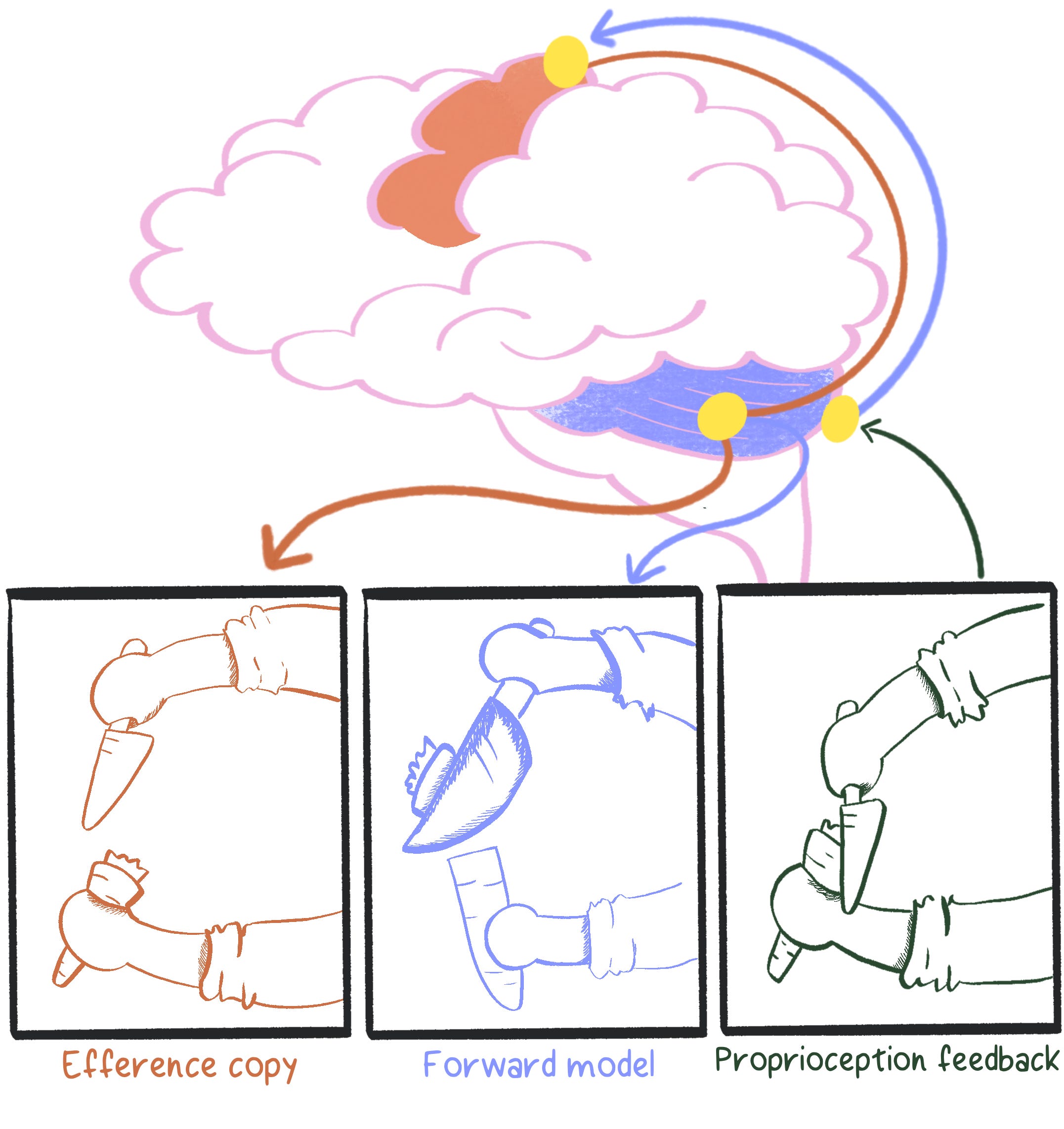
The brain is an interesting computer. It is divided into several different regions that are leading a specific sets of tasks.
The motor cortex (the orange part in the illustration) is the part of the brain that handles “commands” to tell your arm to move, and your hand to grab that carrot and slice it with the knife (first panel). But while it sends these notes to your muscles, it also sends a “carbon copy” of that command to your cerebellum, another region sitting at the base of your skull (depicted in blue in the illustration). The cerebellum’s job is to use this copy to run a mental simulation of the movement. It calculates where the hand, the carrot and the knife should be in 50 milliseconds based on the command it just saw. Scientists call this the “Forward Model” (second panel).
The trouble sometimes, at least in my case, is that this internal simulator is often running a not-so-accurate version of reality. If the predicted position from the forward model does not match with the feedback coming from the muscle sensor (third panel), the cerebellum fires off an error signal and triggers a mid-flight correction. Or at least it should, or maybe it does in well-coordinated people. But for me, the “prediction” was so far from reality that by the time my cerebellum registered the mismatch and sound the siren for a course correction, the knife had already found the wrong target.
What’s the solution
I was wondering if these silly incidents would drop in occurrence if I were more “present”, or significantly less absent-minded.
How many actions do we perform every day without a single conscious thought? Walking, reaching for a mug, or slicing a carrot are movements we relegate to the “background” of our brains. We trust the Forward Model to handle the logistics while we think about our to-do lists or the snowfall outside. But for someone like me, “autopilot” might be a dangerous setting.
There isn’t a simple fix, since I cannot download a software update for my cerebellum. However, there is something to be said for sensory override. If I am “present”, I am giving my brain a second stream of data to work with: visual feedback. It is slower, and it requires more energy, but it acts as a secondary check on my faulty internal simulation.
I would love to tell you that this realization will make me a master of coordination. But as I sit here typing this with a stitched-up finger, I seriously doubt it.
I might still be clumsy, but at least now I know the reason why I trip over my own feet most of the time.